
Long Call Option: How It Works, Formulas, and a Real Example
By OptionsPriceCalculator Team · Published September 27, 2026 · Updated September 27, 2026
A long call is the simplest bullish options strategy: you buy a call option and get the right, but not the obligation, to buy 100 shares of a stock at a fixed strike price before expiration. Your maximum loss is the premium you paid. Your profit potential is unlimited once the stock climbs above the breakeven point (strike + premium).
Think of it as a paid reservation on a stock. You lock in today’s price for a few weeks or months, and if the stock never gets there, you only lose the deposit. To test it with your own numbers, open the long call calculator.
How a Long Call Works: The Four Moving Parts
Every long call trade comes down to four numbers. Get one wrong and the whole position suffers.
- Strike price. The price at which you can buy the shares. Lower strikes cost more; higher strikes are cheaper but need a bigger move.
- Premium. What you pay for the contract, quoted per share. One contract covers 100 shares, so a $5.00 premium costs $500.
- Expiration date. Your deadline. After it, the option either has intrinsic value or it’s worth zero.
- Implied volatility (IV). The market’s forecast of future price swings. High IV inflates the premium you pay.
What happens at expiration
The outcome is binary at the finish line. If the stock closes above the strike, the call is in the money (ITM) and holds intrinsic value. Close at or below the strike, and it expires out of the money (OTM) - worthless.
Most traders never hold to that moment, though. In practice we close long calls before expiration to capture the remaining time value instead of letting it evaporate.
Long Call Formulas: Breakeven, Max Profit, Max Loss
These three formulas are the whole risk map of the trade. Write them down before you click “Buy”.
| Metric | Formula | What it tells you |
|---|---|---|
| Breakeven at expiration | Strike + Premium | Price the stock must reach for a $0 result |
| Maximum profit | Unlimited | Grows $100 per contract for every $1 above breakeven |
| Maximum loss | Premium x 100 x Contracts | Hit when the stock closes at or below the strike |
| P/L at expiration | [max(0, S - K) - Premium] x 100 | S = stock price, K = strike |
A quick sanity check: if your breakeven sits 15% above the current price and you have three weeks left, the market is asking for a lot. Maybe too much.
How It Works in Practice: A Long Call on Apple (AAPL)
Here’s a realistic setup based on market conditions in late September 2026. Apple trades near $335, just after its fall product launch, and the next earnings report lands on October 29, 2026.
You expect the iPhone cycle to push the stock higher by November. Instead of buying 100 shares for about $33,500, you buy one call:
- Contract: AAPL $340 call, expiring November 20, 2026 (about 59 days out)
- Premium: $11.50 per share -> $1,150 total
- Delta: roughly 0.45 (the option gains about $0.45 for each $1 move in AAPL, early on)
Note: the premium is an illustrative estimate based on ~25% implied volatility. Real quotes change every second - check your broker’s option chain before trading.
The math for this trade
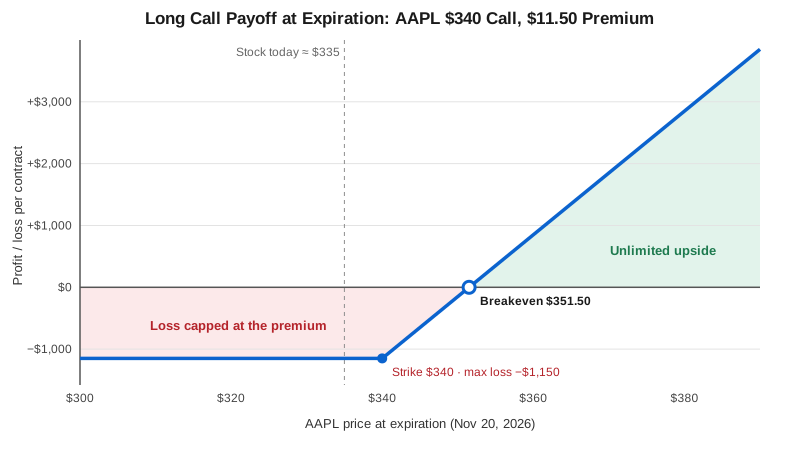
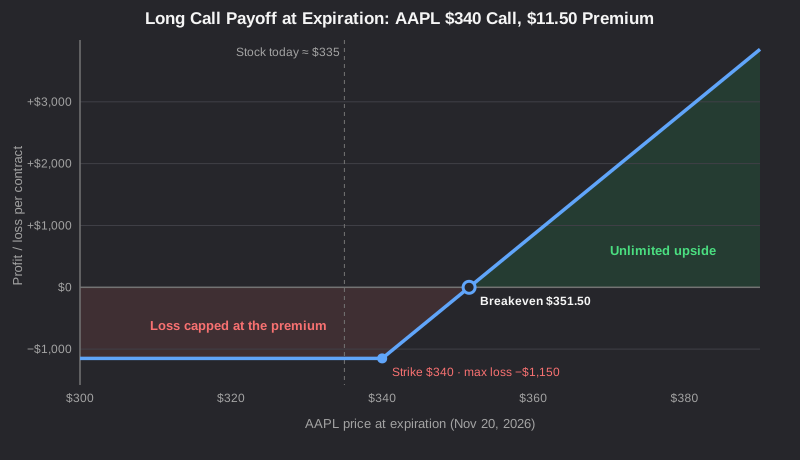
- Breakeven: $340 + $11.50 = $351.50
- Maximum loss: $11.50 x 100 = $1,150
- Maximum profit: unlimited above $351.50
Scenarios at expiration
| AAPL on Nov 20 | Call value | Profit / loss | Return on premium |
|---|---|---|---|
| $320 | $0 | -$1,150 | -100% |
| $340 | $0 | -$1,150 | -100% |
| $345 | $5.00 | -$650 | -57% |
| $351.50 | $11.50 | $0 | 0% |
| $370 | $30.00 | +$1,850 | +161% |
| $390 | $50.00 | +$3,850 | +335% |
Try it yourself: load this AAPL setup in the calculator and move the strike or expiry to see the payoff and Greeks change.
Now compare that with owning the shares. A move from $335 to $370 earns the stockholder $3,500 on $33,500 - about 10%. The call buyer makes $1,850 on $1,150 - about 161%.
That’s leverage. It cuts both ways. If AAPL finishes at $340, the shareholder is up $500, while the call buyer has lost every cent.
Choosing the Strike: ITM vs ATM vs OTM Calls
Strike selection changes the character of the trade more than anything else. Same stock, same expiration, three very different bets.
| Criteria | ITM call ($310) | Near-the-money call ($340) | OTM call ($370) |
|---|---|---|---|
| Est. premium | ~$32.00 ($3,200) | ~$11.50 ($1,150) | ~$3.20 ($320) |
| Delta | ~0.75 | ~0.45 | ~0.17 |
| Breakeven | $342.00 | $351.50 | $373.20 |
| Move needed from $335 | +2.1% | +4.9% | +11.4% |
| Time decay pain | Low | High | Highest (in %) |
| Behaves like | A stock substitute | A balanced directional bet | A lottery ticket |
Here’s my rule of thumb. If I want stock-like exposure with less capital, I buy ITM calls with a delta of 0.70 or more. If I expect a sharp, fast move, I go near the money.
Far OTM calls look cheap. That’s the trap. Most beginners burn their first accounts on $0.50 calls that need a miracle to pay off.
Time Decay: The Hidden Cost of Every Long Call
Every day you hold a call, time quietly eats part of the premium. Traders call this theta decay. For our AAPL $340 call, theta starts at roughly $11 per contract per day and gets hungrier near expiration.
The shape matters more than the number. Decay is slow at 60 days out, then speeds up sharply during the final 30 days.
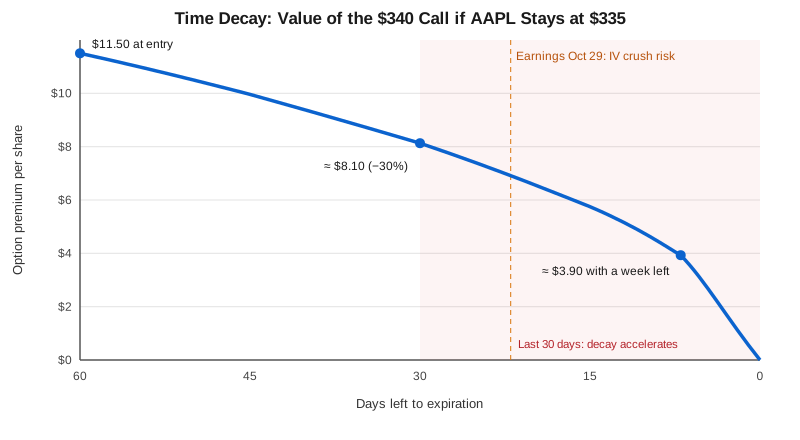
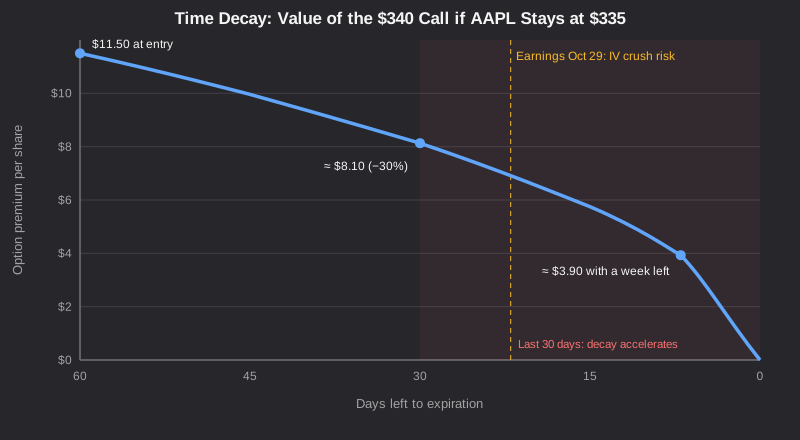
If AAPL simply sits at $335 for a month, the call drops to about $8.10 - a 30% loss without the stock moving at all. With a week left, it’s worth under $4.
How experienced traders manage it
- Buy more time than you need. If your thesis needs 30 days, buy 60-90 days of expiration.
- Exit before the last month. We usually close or roll long calls with 21-30 days left.
- Set a time stop. If the move hasn’t started by a set date, get out and keep what’s left.
Before placing the trade, check your worst case in the calculator.
Risks and Limitations of the Long Call
A long call caps your downside in dollars, but not in percent. Losing 100% of a position is a routine outcome here, not a rare disaster.
- Total premium loss. If the stock stays below the strike at expiration, the option expires worthless.
- Being right but too slow. The stock can rise and you still lose if the move arrives after expiration or doesn’t clear breakeven.
- IV crush. After earnings, implied volatility often collapses overnight. On October 29, AAPL could rise 2% and the call could still lose value.
- Theta drag. Holding a flat position costs money every single day.
- Liquidity costs. Wide bid-ask spreads on less-traded strikes can cost 3-5% of the premium on entry and exit.
- Over-sizing. Cheap contracts tempt traders to buy too many. A sane cap is 1-3% of the account per trade.
When a Long Call Makes Sense (and When It Doesn’t)
It fits when you have a strong bullish view, a clear catalyst, and a defined timeframe. It also fits when you want upside exposure but don’t want to tie up capital in shares.
It doesn’t fit when IV is already sky-high, when you expect only a slow grind higher, or when you can’t afford to lose the full premium. In those cases, a bull call spread or simply owning the stock is often the smarter choice.
Frequently Asked Questions (FAQ)
Can you lose more than you paid on a long call?
No. The most you can lose on a long call is the premium plus commissions.
Do I have to exercise a long call to make money?
No. Most traders sell the call back to the market before expiration and pocket the gain, including any remaining time value.
What is the breakeven formula for a long call?
Breakeven equals strike price plus premium paid. For a $340 call bought at $11.50, that’s $351.50.
What happens if my call expires in the money?
Most brokers automatically exercise calls that are $0.01 or more ITM. Make sure you have the cash to buy 100 shares, or close the position beforehand.
Related strategies
- Twin: Long Put
- Key terms: Call Option, Option Premium, Strike Price, Break-even Price, Leverage, Delta, Theta (Time Decay)
Risk Disclaimer: This article is for educational and informational purposes only and does not constitute investment, financial, legal, or tax advice. Options trading involves substantial risk and is not suitable for all investors; you can lose the entire amount invested in an option. Prices, premiums, and Greeks in the examples are illustrative estimates and may differ from live market data. Past performance does not guarantee future results. Before trading options, read Characteristics and Risks of Standardized Options (OCC) and consult a licensed financial professional.